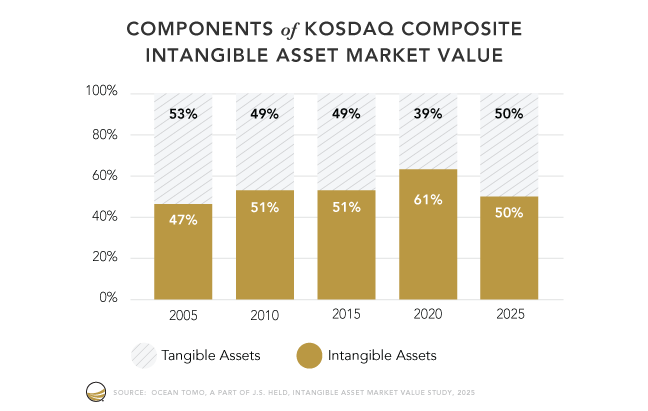
Across the twenty-year history of the Ocean Tomo Intangible Asset Market Value Study (IAMVS), South Korea’s KOSDAQ Composite stands out. South Korea is a global technology leader, yet, on average, the KOSDAQ’s share of intangible asset value has held steady at 50% over the life of the study and fell from a peak of about 61% in 2020 back to roughly 50% by 2025. The KOSDAQ experience teaches IP leaders that technology leadership alone does not set intangible asset value. Industry cycles, export concentration, investor composition, and governance all affect how markets price IP.
Lesson 1: Technology Leadership Alone Does Not Guarantee Intangible Asset Value
In 2022, South Korea held about 60.5% of the global memory market, including an estimated 70.5% share of DRAM and 52.6% of NAND. Yet the KOSDAQ ranks among the most volatile markets in the twenty-year international IAMV panel, and its IAMV fell back toward 50% after the 2020 peak.
For IP Leaders: Holding strong IP and being market-recognized for it are not the same thing. Valuation depends on how investors judge the durability, governance, and risk of the business that owns that IP. In other words, creating leading technology and fully realizing its value are not always synonymous.
Lesson 2: Sector Concentration Magnifies the Cycle
Pandemic-era demand drove memory prices up in 2020 and 2021. The cycle reversed sharply in 2022 and 2023 as PC and smartphone shipments fell, hyperscalers cut inventory, and prices declined. Demand for AI-related high-bandwidth memory (HBM) and advanced packaging brought a strong recovery in 2024 and 2025. However, much of those gains went to large cap firms such as Samsung and SK Hynix (on the KOSPI) rather than to companies in the KOSDAQ ecosystem.
For IP Leaders: When intangible value is tied to a product cycle, it rises and falls with that cycle. A recovery in the broader industry may not reach every company that participates in it.
Lesson 3: Governance is a Valuation Input
The “Korea discount” is a 30 to 40% gap that has been observed between the valuation multiples of Korean technology firms and comparable global peers. It is widely attributed to concerns about minority shareholder protection, concentrated family ownership, cross-shareholdings, and unclear succession planning. Export exposure adds pressure. China accounted for roughly 20% of South Korea’s export volume in 2022 and 2023, which leaves the economy sensitive to Chinese demand and to U.S.–China technology tensions.
For IP Leaders: Markets discount intangible assets whose value realization they believe may not be durable or reliable. Board independence, transparency, and clear ownership structures may affect what investors will pay for IP.
Lesson 4: Speculative Value is Not Durable Value
Retail investors often account for more than half of total trading turnover in Korea. Their trading tends to follow momentum and concentrate in certain areas such as early-stage biotechnology. From 2015 to 2023, several Korean biotech companies with no commercial revenue reached multibillion dollar valuations based on early-stage clinical findings. Clinical failures, trading suspensions, accounting irregularities, and trading suspensions or delistings followed for several prominent firms, destroying value.
For IP Leaders: Intangible value that isn’t backed by evidence of commercial viability can disappear quickly. How well an IP position holds up under scrutiny matters as much as the initial headline valuation.
Conclusion: Intangible Value Must be Earned Twice
The KOSDAQ shows that intangible value has to be earned twice: a company earns it first by building the technology and again by persuading markets that the value will last. South Korea has clearly done the first and its technology record speaks for itself. Its reform agenda – from the Value-up program to the 2025 Korean Commercial Code (KCC) amendments and the KOSDAQ segment reform – is aimed squarely at the second.
The lesson reaches well beyond the KOSDAQ. For IP leaders, protecting and developing intellectual property is only part of the job. The other part is making that value visible and credible to the people who price it. That means sound governance, disciplined capital allocation, clear disclosure, and defined monetization strategies. Companies that manage IP only as a legal or technical asset may leave much of its value unrecognized.
This article draws on Intangible Asset Market Value in the Global Innovation Economy: Macroeconomic Forces, Regional Divergence, and Strategic Implications for Corporate IP Leadership by James E. Malackowski, CPA, CLP, and Matthew Johnson, MA, CLP (SSRN, August 2026). Intangible Asset Market Value in the Global Innovation Economy: Macroeconomic Forces, Regional Divergence, and Strategic Implications for Corporate IP Leadership by James Malackowski, Matthew Johnson :: SSRN.
Transparency Statement: Artificial intelligence tools were used to support the development of this thought leadership content, which could include research support, information synthesis, and editorial refinement. The analysis, insights, perspectives, and conclusions presented are those of the author(s) and reflect their professional expertise and judgment. The content was reviewed by the author(s) for accuracy, relevance, and consistency with the source materials. Artificial intelligence tools did not independently determine the content’s conclusions or recommendations.