



Executive Summary In this post, Joel Lutzker, Managing Director of Ocean Tomo, a part of J.S. Held, and James E. Malackowski, Chief Intellectual Property Officer of J.S. Held, examine artificial intelligence through the lens of intellectual property and intangible asset management. They argue that AI is more than a technology capability. AI systems comprise valuable […]
AI
AI as IP™ Framework: Reasonable Measures in the Age of Artificial Intelligence

Corporate Chief Intellectual Property Officers, General Counsel, and Chief IP Counsel should read this article to: Understand how “reasonable measures” in trade secret, patent, and copyright contexts are evolving as AI systems create, store, modify, and expose valuable intellectual property across technical and organizational layers Advise clients to build AI Asset Registers that document asset […]
Nine Ocean Tomo Experts Named to the 2026 IAM Strategy 300 – The World’s Leading IP Strategists
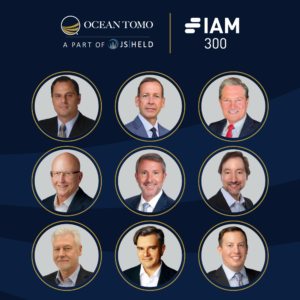
Ocean Tomo, a part of J.S. Held, has nine experts named to the 2026 IAM Strategy 300, the industry guide to the world’s leading intellectual property strategists. The honorees are Gregory Campanella, John A. Hudson, David Kennedy, Brian W. Napper, Larry Tedesco, Ozer Teitelbaum, Marek Wernik, Sam Wiley, and Ryan Zurek. Together they represent all […]
AI Washing and the Imperative for Board Governance

Disclosure: James E. Malackowski serves as Chief Intellectual Property Officer of J.S. Held LLC and as Advisory Board Chair and cofounder of AIQA Global, LLC, which developed the AIQ Score™ methodology referenced in this article. John A. Hudson and J. Scott Womack are Ocean Tomo professionals working in the J.S. Held Office of the CIPO. […]
J.S. Held Launches AI Disputes Monitor to Track Rapidly Growing AI Litigation Landscape

As artificial intelligence (AI) technologies continue to transform industries and redefine business operations, the legal system is grappling with a parallel increase in AI-related litigation. Over the past five years, such litigation has grown at a 56.5% compound annual growth rate (CAGR), with more than 350 cases filed to date. In 2025 alone, 84 new […]
AI as IP™ Framework: A Practical Guide for SMEs to Classify, Protect, and Monetize AI Assets

SME Business Leaders should read this article to: Reframe AI as strategic capital Learn to monetize AI investments Understand IP protections for AI assets Improve investor confidence and valuation Implement a 90-day AI governance plan Legal Advisors should read this article to: Build layered AI IP strategies Draft enforceable AI licensing contracts Guide SMEs on […]
Protecting Intellectual Property Through AI Governance Frameworks

AI systems are composed of three foundational components: data, compute, and algorithms. As we discuss in AI as IP™, among the three foundational components of AI, data often stands out as the most fundamental and valuable. High-quality, relevant, and contemporaneous data can significantly reduce reliance on complex algorithms and expensive computer resources. In many cases, data […]
AI as IP™: A Framework for Boards, Executives, and Investors

This article is the second installment in our three-part series, Artificial Intelligence as Intellectual Property or “AI as IP™”, which explores how artificial intelligence assets should be treated as a form of intellectual property and enterprise capital. The first article, “A Strategic Framework for the Legal Profession”, explored the legal foundations for recognizing and protecting […]